NHS Supply Chain
At the 2025 Hospital Caterers Association (HCA) Forum, Nick Vadis of NHS Supply Chain shared how every day, 100,000 meals are thrown away in the NHS – equating to 36m a year. Annual food waste therefore results in a staggering estimated cost to the sector of £230m and is a significant contributor to the NHS’s carbon footprint.
The figures demonstrate the sheer size of the food waste challenge across the sector and highlight why it’s so important that hospitals take action to bring tangible reductions.
In a drive to reduce food waste, and related costs and carbon emissions, associated with mealtimes in the NHS, frozen meals company apetito conceptualised what it calls ‘a food waste auditing programme to revolutionise patient catering’ that has now been rolled out across numerous partner hospitals.
It is clear that ‘one size doesn’t fit all’ and catering operations vary from site-to-site, so under this scheme an initial audit assesses key areas - ordering, portion control, waste management, and presentation - to gauge food waste levels on each ward. From this, a tailored action plan provides targeted recommendations, helping catering teams implement smart changes to minimise waste during meal services.
To date, the project has found that, on average, hospital sites were producing £9,211 worth of food waste annually per ward – equating to an astonishing £294,752 per hospital.
However, following the auditing process from apetito and subsequent implementation of targeted recommendations, this has been reduced across sites by an impressive 29% on average. These results not only revolutionise food waste management strategies and provide substantial cost savings, but also significantly help to drive down carbon emissions and support the NHS’s goal of Net Zero by 2040.
Neil Hargreaves, general manager of healthcare at apetito, is extremely proud of the initial results seen through this initiative, saying: “As the first initiative of its kind within the NHS, this project has highlighted the urgent need for better food waste management while fostering greater awareness and understanding among staff.
“By delivering tangible sustainability benefits and substantial cost savings, it has demonstrated that meaningful progress is achievable in a short time.
“Whilst these initial results are extremely promising and show brilliant progress, the bigger picture suggests that these types of bespoke audits could make a staggering difference if rolled out across the whole NHS estate.
“We’re in a unique position to deliver a tailored approach to each hospital site through our dedicated training and operations team. By collaborating closely with on-site staff, we make sure a deep understanding and address every detail throughout the catering process – suggesting even small changes in process that can make a real difference to waste reduction.”
Sodexo embeds waste prevention into everyday practice
In 2024 Sodexo’s Fooditude business launched a food waste reduction project which included the development of a unique data collection system and a Power Bi dashboard to analyse waste patterns in its central production kitchen and at client sites.
Fooditude provides delivered-in workplace food services, its high volumes and multi-site distribution creates complex forecasting needs required a tailored approach to food waste measurement.
Third party waste management systems, such as Sodexo’s Waste Watch programme, are not suitable for a central production kitchen model so Fooditude designed and built an in-house food waste tracking system specifically tailored to track and reduce food waste across its operations from its central kitchen through to its client sites.
Since implementing the new system Fooditude has successfully reduced food waste at its central production kitchen by more 46.6%, with client site-level reductions of up to 57%. Monthly waste has reduced from an average 11.5 tonnes to 5 tonnes.
Fooditude’s in-house tracking system enables site-specific analysis and data-led adjustments. It enables Fooditude to produce client dashboards and reports illustrating waste levels, trends and carbon impacts.
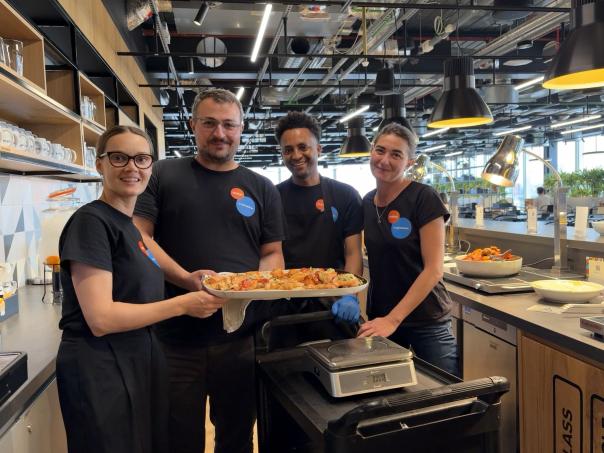
The programme is rooted in a culture of accountability and collaboration. In developing it Fooditude involved its chefs and front-of-house teams as well as its development and operations teams and clients to ensure it was able to analyse data and change ordering practices.
It has embedded waste prevention into daily practice, making it scalable and sustainable for the long term. By re-engineering recipes, retraining teams, and restructuring ordering systems, it has not only reduced waste but also built a culture of problem-solving and shared purpose.
It has been recognised externally, with Fooditude receiving the employee engagement award at the 2025 Planet Mark awards and highly commended at the 2025 Waste2Zero awards.
Nathan Miller, managing director of Fooditude says: “We believe that real change happens when everyone is empowered to take ownership and contribute ideas. This project has shown that, by working together, we can achieve extraordinary results for our clients, our communities, and the planet. I am incredibly proud of our people for making sustainability a core part of their daily work.”
Fooditude aims to have all client sites onboarded by the end of 2026, integrating waste tracking into every new site mobilisation.