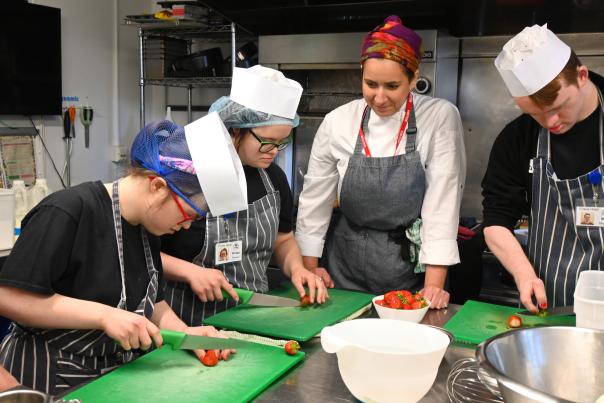
There are 1.5m people with a learning disability in the UK. This is a staggering figure and one every industry should be mindful of, especially catering and hospitality. As an industry, though, are we doing enough to encourage a diverse workforce and offer the inclusive training that the Special Educational Needs (SEN) community needs?
Whatever the sector, finding a job can be incredibly tough for people with a learning disability. To put it into perspective, currently around three quarters (75%) of the general population are in employment; just over half (53.1%) of disabled people are employed, and for people with a learning disability, the employment rate is half that. This is according to Mencap, the learning disability charity.
Jackie O’Sullivan, executive director of strategy and influence at Mencap, explains some of the hurdles SEN people are faced with when looking for a job.
“Barriers such as inaccessible application forms and recruitment processes, or simply an inflexibility around providing support can squash ambitions and prevent capable people from participating in the workforce.”
“At Mencap,” she says, “We know that with the right support, people with a learning disability can thrive in the workplace, bringing commitment, creativity and loyalty to the teams they join. Yet too often, systematic barriers and misconceptions prevent talented individuals from accessing opportunities in sectors like catering, which are ideally suited to inclusive employment.”
Leading the way
Having said that, Jackie believes that catering is an industry that does offer a unique opportunity to lead the way for SEN. She says: “Roles in this sector offer structure, routine and practical skill-building, which are all key factors in successful employment for people with a learning disability.
“By making recruitment processes accessible, providing disability awareness training for managers, and working with organisations like Mencap, employers can unlock a motivated and reliable talent pool.”
Julian Edwards, the chair of Foodservice Consultants Society International (UK & I), agrees. “Contract catering is a brilliant sector for SEN employment - it offers structured tasks, routine, teamwork and visible success.”
He also believes that caterers are in a ‘uniquely influential position’ because they shape daily experiences around food, routine, independence and belonging.
“When they get SEN engagement right,” he says, “It can improve dignity, safety, customer satisfaction and workforce diversity.”
One contract caterer that is making significant effort in this area is Lexington Catering, which claims that as a business, ‘it takes a practical, inclusive approach to diversity - including supporting people with SEN’.
Laura Noone, people manager at Lexington Catering, says that this is embedded across the business and is reflected in how it ‘recruits, trains and supports its teams’.
The recruitment process, for instance, allows candidates to choose the interview format that best works for them, which could be a traditional interview process, a trial shift, or perhaps a walk and a chat over a coffee.
And BaxterStorey has designed its recruitment process so it is accessible from end to end. Lyndsey Oliver, head of ED&I at the caterer explains how it works.
“We ask candidates about workplace adjustments from the outset, allowing us to provide the right support so that individuals demonstrate the best version of themselves throughout the recruitment journey.
“For applicants coming through our social mobile partnerships,” she adds, “we also offer a bespoke recruitment pathway that removes the standardised application process entirely. This tailored approach provides greater flexibility and support, including individualised adjustments and guidance through onboarding and into that role.”
Importance of training
Training is also a key area that caterers must focus on when it comes to SEN. At Lexington Catering, for instance, everyone has access to training on disability awareness, communication techniques and reasonable adjustments - covering both visible and hidden disabilities such as autism and ADHD.
And teams working directly alongside SEN interns or employees also receive practical, tailored guidance to support the individuals they work with.
Says Laura Noone: “We also work with local colleges to deliver internships, giving people with SEN hands-on experience in kitchen and front-of-house roles, alongside offering appropriate supervision and reasonable adjustments.”
With one client alone, the caterer has delivered 22 supported placements to date, with interns benefitting from mock interviews and employability workshops.
She adds: “Placements typically last eight to 12 weeks and, where possible, we work closely with college job coaches to support interns into permanent roles. From that group of 22, three have progressed into securing permanent roles at Lexington, while a further three have paid employment elsewhere.”
Meanwhile, Ben Schobs, catering manager at BM Caterers & Neurodiversity ambassador/access champion, says training delivered by a neurodiversity specialist is mandatory across its business.
“This ensures inclusive leadership is embedded across our operations.”
He explains that reasonable adjustments within the business are also treated as standard, not exceptional. “These can include noise-reducing earphones, access to sensory-safe spaces where possible and clear communication delivered both verbally and visually.
“We also use Personal Passports, allowing individuals to clearly set out any support or adjustments they need to do their best work.
“Alongside this,” explains Ben, “We are developing tailored leadership training focused on managing sensory overload, communicating calmly under pressure and supporting people through change with clarity and empathy.
“We also work closely with charities, colleges and schools to promote inclusive pathways into hospitality and to give honest insight into what a career in the industry involves.”
Sodexo, a global services provider, also sees the value in investing in training - so much so that it has developed and deployed a neurodiversity awareness course which is aimed at managers, offering them insight into neurodiversity and how to cultivate an inclusive working environment for neurodiverse colleagues.
The sessions cover managing change, facilitating inclusive meetings and ensuring clear communication.
It also partners with leading organisations to help create supported work placements for SEN individuals. For example, it recently celebrated its ten-year partnership with The Aurora Group, a hospitality and catering college for young people with learning disabilities. The company also works closely with DFN Project SEARCH, a transition to work programme for students with learning disabilities and autism spectrum conditions.
In addition, Sodexo runs its Ability Employee Network, which aims to ‘facilitate conversations around neurodiversity and act as a platform to connect colleagues to share experiences and deliver valuable initiatives’.
Is the industry doing enough?
There is undoubtedly some fantastic work going on across the industry to support and empower SEN people within contract catering. Hearing from four leading contract caterers about the positive actions they are taking might suggest that the industry is doing more than its fair share to empower SEN.
However, according to these caterers there is still more the industry can and needs to be doing.
Laura at Lexington Catering says: “There is often hesitation around neurodiversity, driven by concerns about day-to-day management, team impact or a fear of getting things wrong. Too often this leads to inaction - similar to the attitudes historically seen around mental health and other disabilities.”
For Laura, education is key. “We need to do more to help the industry understand the true value of a diverse workforce, including the different skills, perspectives and ways of thinking that neurodivergent colleagues bring. Neurodivergence is a complex area, and while we’ve made a start, there is still a lot more work to do across the industry.”
Lyndsey of BaxterStorey says that greater collaboration, more flexible recruitment practices, and a shift away from one-size-fits-all approaches will be the key to unlocking opportunities for SEN people.
“By focusing on individual strengths and designing workplaces that are inclusive by default, we can collectively create an industry where everyone has the opportunity to succeed,” she says.
Ben at BM Caterers agrees that more needs to be done. “While there are pockets of excellent practice, they are often driven by individuals rather than embedded systems. That means support can be uneven and overly dependent on having the ‘right’ manager or workplace culture.
“That said,” he adds, “the opportunity to do better is very real. Too often support only appears once someone is already struggling, burning out or in a crisis. Adjustments are treated as exceptions rather than part of everyday working practice.
“Inclusion shouldn’t begin with a problem, it should be built in from day one.”
Jackie of Mencap adds: “Inclusive employment is good for people, good for business and good for society. We hope we can inspire catering providers to help close the employment gap for people with a learning disability.”
In the end inclusive employment isn’t separate from good management - it’s part of it. Many businesses find that supporting SEN colleagues leads to stronger teams, improved morale, and better service for everyone.