Why the UK needs public restaurants and why is this relevant to public sector catering?
Across both the private and public sectors, catering is under pressure. In hospitality, rising costs across energy, labour and ingredients are making the headlines.
And, whilst there have been high-profile closures, many of the more established groups and operators continue to perform well and grow. The strongest have adapted by refining menus, tightening operations and building more diverse portfolios that help manage risk and reach different parts of the market.
In the public sector, food provision faces a different but equally complex challenge. The cost of school meals is a constant pressure point, and over the past decade many institutions, including hospitals and universities, have outsourced catering in an effort to manage risk and control costs.
Yet strong in-house provision proves that catering doesn’t have to be a cost burden. Organisations such as Neller Davies, working across multiple NHS trusts, and initiatives like the Clever Cuisine system at the University of Reading show that catering can deliver operational excellence without becoming a cost burden to the institutions they serve.
In both these cases, catering is increasingly seen as a strategic asset rather than simply a service. At the university, there are clear links between food provision, student wellbeing and retention. Across hospital settings, similar benefits are being seen for patients, visitors and staff.
What this points to is an opportunity, through catering, to address some of our biggest social challenges with a prevention first approach. By drawing on the strengths of catering in both the public and private sectors, we can create something new: public restaurants that support healthier diets and reduce loneliness, at population level.
The Public Plate is the model we have developed to bring these elements together. From hospitality, it takes the risk diversification, efficiency and customer experience. From public sector catering, it takes scale, consistency and the ability to deliver against wider social outcomes.
The Public Plate has been designed to support a network of public restaurants that are commercially viable yet built to serve a broader public purpose; harnessing catering’s unique potential for social good.
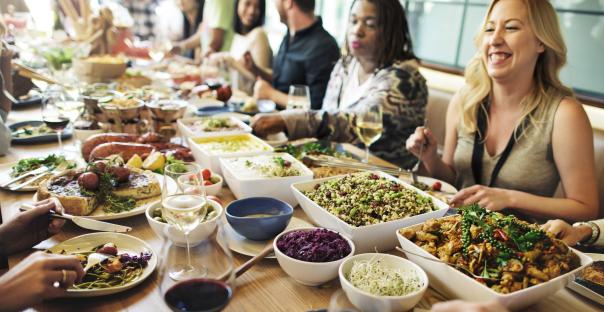
What are public restaurants? Public restaurants are designed to fill a gap left by places we’ve gradually lost: Sure Start centres, department store cafés and workplace canteens. The spaces where people could regularly and affordably sit, eat, and be around others. In many ways, they are the food halls of the future; flexible, informal and sociable.
But unlike traditional food halls with multiple vendors, public restaurants have a single kitchen and a focused menu. A small number of dishes, cooked in volume and served simply, keeps costs low while maintaining quality. The result is a place people can return to often, rather than just occasionally.
Public restaurants combine scale, accessibility, and sociability with a commitment to food that is good for both people and the planet. Meals are priced around £10, with a long-term ambition to widen access further through cross-subsidy and partnerships.
By serving generous, affordable, climate-friendly food, public restaurants become spaces where we can eat well without overspending, and where connection happens naturally, whether we dine with, or simply in the company of, others.
What does this have to do with public sector catering?
Among the many concerns discussed at January’s Public Sector Catering ‘Most Influential’ roundtable debate was the growing pressure on public sector catering budgets. Rising national insurance contributions and food costs are forcing many caterers to source cheaper products. The result is a lose–lose situation.
Those eating the food experience lower quality meals; the environment suffers, as cheaper products are often more harmful to the climate; and the sense of pride and self-esteem among catering teams is diminished. Farmers, too, lose out, unable to compete on cost with imports produced to different standards.
This sits in direct tension with a broader national urgency: the UK’s diet needs to become more sustainable to support food security and address climate change. We cannot afford for it to move in the opposite direction. There was clear agreement that public sector catering has a vital role to play in modelling what good nutrition looks like, and in supporting positive outcomes for health, the environment, and communities.
Anna Taylor of the Food Foundation was clear that public food must-and can-pave the way and Professor Kevin Morgan highlighted the need for better stories to communicate these benefits and build wider support.
Public restaurants offer a practical way to test many of the ideas in the real world. By combining commercial viability with social purpose, they create a model for widening access to nutritious, climate-friendly food as part of everyday life. In doing so, they provide a route to delivering meals that people not only enjoy eating, but feel proud to serve.
The Public Plate Model
Through The Public Plate, public restaurants will scale through developing shared infrastructure for finance, central food production, back-office operations, and system-level regulation.
By operating in the open market and delivering a product that people are keen to access regularly, the model will generate reliable income and build financial resilience. This ensures the service is economically viable while intentionally supporting wider public outcomes over time.
How will The Public Plate achieve this?
Currently, across catering we see a siloed approach to health, procurement, regenerative farming practices and the economy. Public restaurants, by design, can cut across these siloes and will do so whilst being commercially run, without being profit maximising. Key principles of the operational and organisational design include:
1. Supply-led, plant-forward menus: Menus are designed in collaboration with suppliers and shaped by what is in season and available, not just what is demanded. The result is food that supports both wellbeing and more sustainable farming systems.
2. Centralised production and coordinated supply: A hub-and-spoke model aggregates demand across sites and prioritises agro-ecologically grown food. Central processing handles the heavy-lift preparation, reducing operational risk, cost and complexity at site level while improving consistency, reducing waste, and creating stable demand for producers.
3. By reinvesting financial surpluses, in time the model supports a scaled pricing structure that will make good food accessible to more people, without compromising on quality or long-term viability.
4. Social franchising distributes ownership and risk: Public restaurants are run by local operators and upfront investment is enabled through patient capital. This allows ownership to be achieved through performance without reliance on wealth.
5. Technology that enables, but not replaces, human interaction: Digital systems streamline transactions and operations, allowing teams to focus on food, hosting, and the social experience of eating amongst others.
6. Relationships are at the core of the model: Long-term relationships are desired and invested in so that they become the norm.
7. Governance and funding are in service to the purpose, not the other way around. Both are designed so that growth does not see the mission diluted, but rather strengthened.
This is not about reinventing restaurants. It is about taking what already works and organising it differently. Sometimes it starts with the belief that things don’t need to be the way they’ve always been. Sometimes it starts with intent. Now what? The ambition is to launch public restaurant pilots in contrasting settings to test both the operational model and public demand.
Alongside this, we will work alongside evaluation partners to assess long-term outcomes and impact around local economies, stronger networks, increased access to affordable, balanced and nutritious meals eaten out of the home and supply chains that, at scale, support a growing agro-ecological farming sector.
Crucially, public restaurants are not intended to replace what already exists, the UK has a strong hospitality sector and a vital public sector catering system.
But there is space between them for a model designed for regular use. If we want different outcomes; from health to social connection to local economies, we need to design different everyday experiences and public restaurants are one way to do that.