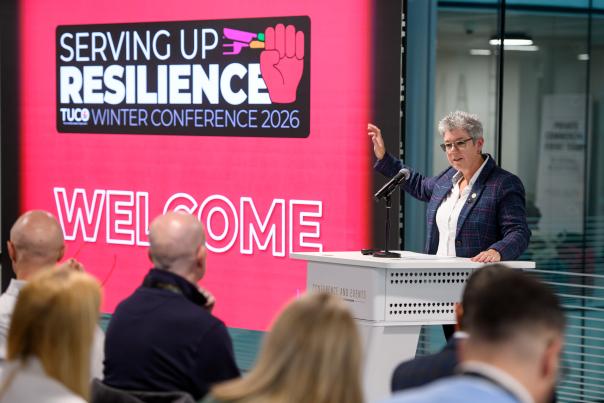
The venue for the TUCO Winter Conference was University College Birmingham, which welcomed 138 delegates from across the UK to the one-day event celebrating innovation, sustainability, and excellence in higher education catering.
The conference, themed ‘Serving Up Resilience’, explored how in-house teams are responding to changing student expectations, rising sustainability targets, and the challenges of delivering high-quality dining experiences on campus.
The day began with Mark Kassapian from Litmus Partnership presenting the Business Models in Higher Education Catering report. His session highlighted current operating models across universities, benchmarking insights, and practical recommendations to help catering teams improve their efficiency as well as the quality of the student experience.
Delegates were able to gain valuable insight into how institutions can adapt and optimise their catering operations to meet both financial and sustainability goals.
Peer-to-peer presentations formed the core of the conference, offering delegates practical case study examples from universities that are already ‘putting innovation into action’.
King’s College London showcased its Root to Tip project, led by Dr Rachel Gibson, Dr Balazs Bajka, Dr Fatima Wang, Dr Fiona Lavelle, Lisa Connellan and Georgia Browne.
The initiative encourages the use of fruit and vegetable parts that are usually discarded. The effect is to increase dietary fibre intake while reducing food waste. Over nine weeks, 6,000 Root to Tip meals were served, saving 241kg of food and adding 3.6kg of fibre across all menus.
The KCL team shared insights into engaging students and staff, using social media, focus groups, and QR surveys to build awareness.
They also explored cultural attitudes towards peels and stalks, safety considerations, and practical approaches to recipe development, demonstrating how in-house catering can act as a laboratory for research and behaviour change.
The University of Salford’s Matthew Mealing and Andrew Flowers shared from their own experience how sustainability initiatives and integrated campus services can improve both operational efficiency and the student experience.
And the University of Strathclyde’s Graham Paterson and Gordon Hodge highlighted strategies for embedding catering into institutional strategy, focusing on resilience, partnership working, and continuous service improvement in a competitive urban environment.
At the University of Chester, Paula Martindale, Dan Hultum and Jackie Rowlands presented the results of how their team used data-driven decision-making and innovative service models to enhance student satisfaction, reduce waste, and support staff well-being.
Their session illustrated the power of operational insight combined with community engagement to drive long-term performance improvements.
The day concluded with an inspiring keynote address from Mark Ormrod MBE, the former Royal Marines commando and world-class adaptive athlete.
He shared his journey of resilience, leadership, and determination, offering delegates powerful lessons on overcoming adversity, setting ambitious goals, and applying a growth mindset in both personal and professional life.
Delegates rounded off the day with an evening dinner and networking as they reflected on the insights shared and looked to forge new connections across the TUCO community.
Following the conference, many participants continued on the Winter Conference Study Tour, which explored Birmingham’s vibrant food and hospitality scene through market visits, supplier tours, and curated experiences.
The TUCO Winter Conference 2026 demonstrated the strength and creativity of in-house public sector catering teams, and how collaboration, research, and innovation can deliver both healthier, more sustainable meals and a better student experience.