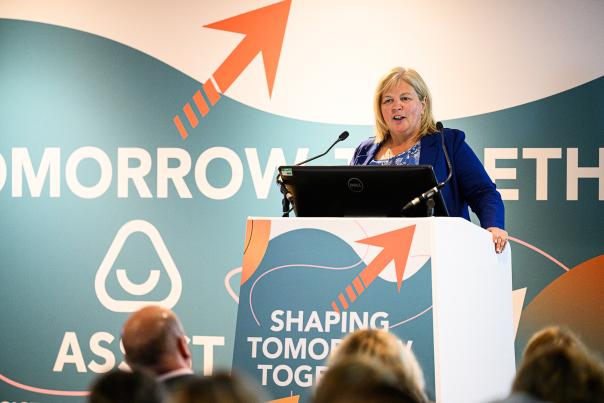
Former chair Chris Ross was the conference host and current chair Nicky Joiner kicked off the two-day event with a welcome for delegates. She said the event offered a comprehensive exploration of legislative shifts, technological innovations, and pressing workplace welfare challenges.
Running alongside the event was a bustling exhibition area where suppliers showcased the latest in food, drink, equipment, and software. With public services facing tight budgets and shifting political landscapes, the event underscored a collective determination to evolve through collaboration and resilience.
Good Food Nation
The opening session focused sharply on the Good Food Nation (GFN) Act. Lesley Curtis, a GFN policy official, delivered a crucial implementation update, emphasizing the necessity of a ‘whole food system’ approach over piecemeal initiatives. Under the Act, the independent Scottish Food Commission will support and review national and local progress.
Crucially, she said, local authorities must design and consult on their own distinct plans, identifying clear outcomes, indicators, and policy measures. While aligned with national core principles, LAs retained the flexibility to address localised needs.
She said it was expected work would begin on local plans by April 2027 at the latest with April 2028 the expected statutory publication deadline.
Curtis acknowledged that dedicated funding allocations were paused due to the recent Holyrood election, leaving local authorities waiting for the newly appointed minister to approve financial backing. However, she said Section 10 was firmly expected to be in place by April 2027. She argued that the GFN framework served as a vital bridge, aligning work already underway regarding health inequalities, local economic resilience, and Net Zero targets.
Addressing private food sectors, Curtis confirmed that bringing commercial companies on board was a priority, alongside potential national branding to help the public connect local council initiatives with broader GFN policy goals.
Menopause in workplace
Welfare took centre stage with a vital presentation from Professor Kathleen Riach of the Adam Smith Business School, focusing on menopause and mental health in the workplace.
Riach highlighted that with the average age of menopause hitting 51, and a transition period lasting 5–7 years, fluctuating symptoms heavily disrupted the workforce. In a recent survey, 77% of respondents felt the menopause disrupted their work, while 45% felt their working environment actively aggravated their symptoms.
For facilities management (FM) teams, ‘deskless’ operational environments make managing these challenges uniquely difficult, often leaving staff feeling hesitant to raise the issue with management.
She emphasised that under the Equality Act 2010 and the upcoming Employment Rights Act 2025, larger organisations faced compulsory requirements to address gender equality. She advocated for the low-resource, high-impact MAPLE framework:
- Micro-accommodations (e.g., mobile fans, flexible breaks)
- Allyship (managerial recognition and breaking bias)
- Physical environment adaptations (eg. breathable uniform materials)
- Line management training (enabling open, affirmative conversations)
- Education (dispelling workplace myths)
Mental health in workplace
Following this, Charlie Hodson from Hospitality Action delivered a moving personal testimony regarding his battles with childhood trauma, severe alcohol abuse, and suicide attempts.
Acknowledging the lifesaving, instant-access support he received from the charity in 2019, Hodson reminded delegates that Hospitality Action stood ready to aid public sector catering staff through setbacks, advice, grants, and the ‘Golden Friends’ scheme to combat isolation in retirement.
To champion this cause, Hodson highlighted the upcoming Walk for Wellbeing in October and detailed his own 274-mile rough-sleeping walk to Bath planned for later this year.
Smart cleaning technology
A panel discussion chaired by Anne Goldie set out to demystify the integration of smart cleaning technology, introducing the concept of ‘co-botics’ - machines designed to supplement and assist human cleaners rather than replace them.
The conference heard East Ayrshire had invested in autonomous scrubber-driers via an innovation fund. They were capable cleaning 2,500 sq m sports halls and corridors. In Renfrewshire they used three-week trials before introducing ‘co-bots’; stressing the importance of early union engagement to build trust and reassure staff.
Highland Council highlighted infrastructure needs, Wi-Fi dependency, and managing lithium battery fire risks. The panel advised starting small with dedicated, well-trained teams, ensuring early engagement with building users, IT support, and fire safety officers to manage workflows and technical infrastructure.
Concluding the day, polar adventurer Victoria Humphries shared lessons on resilience and coping with change. She reminded delegates that facing failure was a natural element of progress, noting that true resilience lay not in individual physical strength, but in having the bravery to face challenges and ask for assistance if you needed it.
Universal Primary Free School Meals
On day two Professor Kevin Morgan of Cardiff University opened the conference by mapping Universal Primary Free School Meals (UPFSM) across the UK. He contrasted England’s rapidly shrinking, fragmented local authority landscape with Scotland and Wales, where provision remains protected by legislation like the Good Food Nation Act.
He argued that universal provision was the single highest-return that could be achieved through investment in public health and social development. And he countered concerns about the cost by highlighting the ‘staggering’ £260bn economic burden currently incurred by poor health outcomes in the UK.
However, he said entrenched food cultures presented a distinct barrier and benefit-based uptake remained lowest in the most socio-economically deprived areas. The consensus was clear though: simply placing healthy food on a school menu is insufficient; it must be reinforced by proactive family education, marketing, and simple home-cooking recipes.
Nourishing Nurseries
Kirsteen Innes of Edinburgh Community Food demonstrated this engagement in action when she spoke about the ‘Nourishing Nurseries’ initiative. This six-month scheme targeted children under five to foster vegetable familiarity.
By involving over 100 toddlers in unpacking, washing, and preparing fresh ingredients alongside local growers, the charity successfully embedded positive food experiences into early family life, building a strong case for expanded funding.
Technical insights
Further technical insights came from Jim Melvin of the British Cleaning Council, who announced a groundbreaking efficiency trial across 18 schools in South London, Birmingham, and Derby.
By monitoring student illness and absence records against enhanced hygiene regimes, the council aimed to produce definitive economic evidence proving that robust cleaning protocols directly reduced school absenteeism.
Closing the event, Gary Ennis of NS Design returned to the technological thread, offering a practical guide to Artificial Intelligence tools like Claude and Fyxer.ai. Reinforcing the themes of the co-botics panel, Ennis insisted that AI should augment human workers rather than replace them.
Urging delegates to treat Large Language Models with ‘caution, care, and consent,’ he warned against ‘data hallucinations’ when things are ‘made up’ and pattern-recognition biases caused by the sometimes skewed research data that AI draws from.