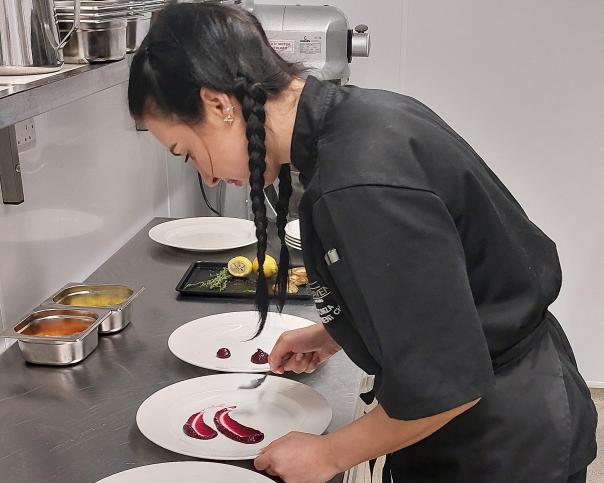
David Foad: How did you first get interested in cooking?
Ilona Tomza: Growing up in Poland my father was a butcher, if there was a chicken for dinner I held it while he killed it. He also went foraging and fishing and took me with him. What we brought back we cooked together. He would get me to taste things and ask me what was missing.
DF: What was your first job in the kitchen?
IT: I came to the UK and worked as a waitress at The Crown in Cirencester. The chef was not very good and I felt embarrassed to take the food out sometimes. When I told him he said, ‘well see if you can do any better’. So I started working in the kitchen as well. When the owner found out he gave me a full-time role in the kitchen and within six months I was the second chef.
DF: Why did you make the move into care catering?
IT: I was waiting to take over as head chef, but still working late nights and going nowhere so I needed a Plan B. I knew someone who worked at Hunters Lodge Care Home in Cirencester and they told me to check it out. They offered me a job and I spent over four years there, gaining my NVQ certificates at the same time. Later the senior manager moved to Porthaven Care Homes and recommended me, so I started work at its Marlborough site as head chef. I loved it there. We had a catering team of seven and the rest of the team is still there now, ten years later.
DF: Tell us about your job as development chef-innovation with Porthaven Care Homes
IT: I travel round Porthaven’s various care homes, looking at how things work in the catering and seeing how I can work with head chefs to tackle food production problems. I get involved in recipe and menu development, particularly with texture-modified food, and I do IDSSI (International Dysphagia Diet Standardisation Initiative) training with teams.
DF: Are meals made from fresh ingredients? What sort of choices do residents have?
IT: Yes, as much as we possibly can. I am a great believer in using seasonal produce. If a fruit is not in season, we use one that is, adapting recipes as necessary.
A typical breakfast menu is fruit salad, cereals, toast, and yogurt. At lunchtime at this time of year we might offer soup, a beef and horseradish stew with dumplings, or baked fish with mushrooms. Desserts will be things liked a Biscoff mousse or fruit salad. There is also afternoon tea offered for those that want it, along with snacks available 24 hours a day. But if a resident has a particular request on any day we do our best to try to provide it no matter what’s on the menu.
We cut any fruit and vegetables so they can also be used for cutlery-free dining, which works for some people with dementia. They can be used with a sauce for serving on a plate, or served with the sauce as a dip for finger food.
DF: How did you got involved in the Care Chef of the Year competition?
IT: This was my second year, I entered last year but didn’t get through the initial paper judging round. This time I tried to really get behind the brief to produce something simple, stripped down, that residents would like but which also has a dementia aspect.
DF: What did you cook and why?
IT: My Muscovado Coq au Vin did not use wine but balsamic vinegar and brown sugar, which recreated the real flavour but is cheaper. And I put a lot of time into getting the garnishes right – candied baby onions and mushrooms – so they reflected what was in the dish. I also added butter and sugar, which makes it moreish, because we mustn’t forget the pleasure we get from eating.
DF: Did you use your residents as test subjects?
IT: The dish I chose was on the menu, so I knew they already liked it.
DF: How did you find the experience of cooking alongside the other finalists?
IT: I think we all understood that we have to work together to help ourselves do our best. And I knew some people from the regional round so we were all quite friendly and relaxed about it. I even made friends. The kitchen for the regional round was in a school and very old-fashioned, so that took a bit of getting used to. But the final was at Loughborough College and everything there was very good. We even got some ‘little chefs’ from among the college students to help us as commis chefs. That was great.
DF: What did you think of what the other finalists cooked?
IT: There was a lot of very good food cooked. We have a lot of very food chefs working in the care sector.
DF: What was it like when you were announced as winner?
IT: I was pleased with my dessert, but not so much with the main course. I am my own harshest critic. So when they announced that I had won the prize for best main course, I was confident I would be the overall winner.
DF: What’s been the reaction from family, friends, colleagues?
IT: At work everyone has been very kind, and there was a small celebration for me when I got back. And when I phoned my partner and told him I had won, he said I was always telling him at home that I was the best chef and ‘you were telling the truth, weren’t you’.
DF: Has taking part in the competition helped improve you as a chef?
IT: It’s made me realise that really simple processes can still be very challenging. And I would say that it has emphasised to me that I should concentrate on flavour rather than technique – though you do need some sort of balance.
DF: What’s your advice to other care chefs considering entering the competition?
IT: I would say, absolutely, go for it if you can take the pressure. It means you can measure your own skills, you can see how others do things – every day is a school day. You might get a new take on something. Get the confidence that comes from doing something a bit risky.
DF: What’s the year ahead got in store for the Care Chef of the Year?
IT: Already I have taken part in an Alaskan Seafood chef’s forum at the University of West London. I particularly enjoyed working with the students there and talking to them about the career opportunities available. I don’t believe there’s stigma any more attached to working in a care home. You get work-life balance, you have to be more skilled than a restaurant chef, and you can cook meals for people who appreciate them so much because it might be the last meal they ever have.