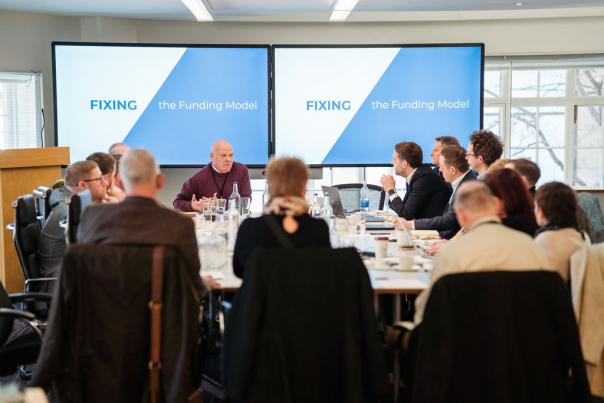
Leaders of local authority providers, private not-for-profit organisations, contract caterers and consultants joined academics and representatives of the Department for Education in London yesterday (February 17) to test out some ideas.
Brad Pearce, chair of TSFP (formerly known as LACA) told the meeting: “There is an issue with the provision and funding of school food, particularly in England, where we currently get £2.61 a meal.
“We recognise the financial pressures – six or seven local authority services have already announced they are to close this year.”
He said that labour costs had risen 28% in just the last few years, food and labour together by more than 50%, while the increase in employers National Insurance had gone up 19%.
“We want to look at how we go forward,” he said.
Professor Greta Defeyter of Northumbria University briefly laid out some of the reasons for the current crisis in England, pointing to the fragmentation of both the schools system itself with the introduction of academies, and the catering system.
She added there were multiple funding streams involved in covering costs and little to no coordination among them.
She highlighted school dinner money debt as a large, unknown drain on school budgets, and suggested the ‘census day’ approach to calculating uptake was flawed.
Professor Paul Stretesky of the University of Lincoln looked at how adjusting the current funding model would impact how much a school received.
He focused on the suggestion of providing a £495 annual lump sum for each pupil based on an 85% uptake, rather than the £2.61 per meal model that exists.
He said it might help address the issue that bigger schools are currently more economic than smaller ones, but warned it could exacerbate the differences between schools with many free school meal pupils and those with few.
Adam Curtis of Dolce Catering showed the meeting some figures he had put together that showed the variable impact of mixing levels of funding from fixed price meals, paid-for meals, and an annual lump sum of £495 per pupil.
He said that by reducing the meal price for FSM from £2.61, introducing a fixed sum of £495 per pupil and setting the paid-for price at £3 then it would level the playing field for most schools and so be fairer.
Luke Consiglio of school meals contractor The Pantry said that while he supported the idea of fairer funding, he believed the process of assessing and introducing such a model would take too long and many school meal providers would have gone out of business in the meantime.
Neil Fuller of Caterlink said the issue was actually not so much with school catering funding as with school funding generally, which was too low and forcing head teachers to look at lowest cost options in catering to be able to afford classroom assistants and equipment.
Following a lively discussion Brad Pearce summarised the next steps by urging everyone involved in the industry to participate in the enquiry by All-Party Parliamentary Group on School Meals, which was starting this spring.
He added that he would be following up with all the roundtable participants about how to take the discussion forward to the next phase.