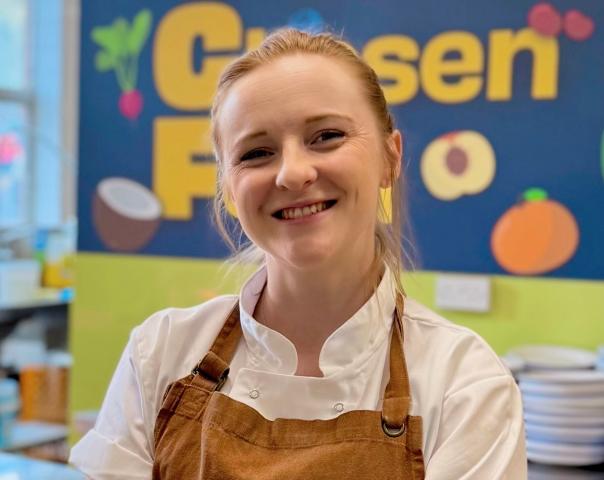
Try Something New Day launched on 24th February through charity Chefs in Schools, offering schools a free toolkit to run ingredient tastings during breaktime — no classroom time, no external budget required.
Swapping Michelin kitchens to schools
Francis created Try Something New Day after making an unconventional career move. Over a decade of fine dining experience — including The Ritz London, The Dairy, and opening Michelin Guide-listed restaurant Maene as head chef — prepared her for a different challenge.
In late 2023, she left fine dining to become head chef and senior food educator at Christ’s College Finchley, a secondary school in North London. Since then she’s gone on to win Great British Menu’s highest accolade, while still working in a school kitchen.
Try Something New Day origin
Every Tuesday, she wheels a trolley out into the school dining hall, offering students a new ingredient to try, free of charge — no questions asked.
“It’s five seconds out of their day, but it’s a big achievement in the long run,” says Francis. “The aim is to encourage conversations around ingredients — from different types of tomato to lesser-known flavours like kohlrabi and pomelo.”
Junk food ban
The Government’s latest ban on junk food adverts online and before 9pm is one step towards steering young people to healthier choices, but the campaign argues that this must be matched by more opportunities for children to try real, nutritious ingredients to broaden their tastes.
Chefs in Schools is now taking Francis’ idea to all primary and secondary schools and has created a simple ‘how to’ guide that any school can follow.
Cost and practicality
Francis budgets just a few pounds per week for a school of over 1,000 pupils. “We have no external budget for this; I put aside a certain amount per week to cover two to three kilos of an ingredient.”
For catering professionals and suppliers, Try Something New Day presents an opportunity to support schools in their networks. Seasonal surplus, ingredient donations, or simply sharing the free resource pack with school clients all enable more schools to participate.
Amber’s top tips
Start simple. My favourite thing to do is to take something basic like cucumbers, apples or oranges, offer three different varieties and discuss their differences.
Smell or touch is fine. There is no pressure to eat the ingredient. Keep a few whole versions back so students can see what it’s like before it’s chopped up. Go further — if they’re up for it. Students have sometimes come up with pairing suggestions.
Try spices. Ask students to taste, smell and crunch on spices, such as cumin and coriander seeds, or pop a cardamom pod to see what’s inside.
Importance of food education
Nicole Pisani, co-founder of Chefs in Schools and former head chef at Ottolenghi’s NOPI, said: “Food education doesn’t have to be in a classroom, it can be a simple addition to lunch or breaktime. We know that varied diets are key to healthy development and we find that children and teenagers are more likely to experiment with new flavours if we make sure the opportunities and encouragement are readily available during the school day.”
What this means for the profession
Francis’s move from fine dining to school kitchens reflects a growing trend in the catering profession: chefs seeking roles with social impact alongside culinary excellence.
Try Something New Day is designed to be replicable by school chefs at any level, proving that high-quality food education doesn’t require Michelin-starred credentials — just commitment and a few pounds of kohlrabi.
The campaign is backed by a growing body of evidence showing that sensory food education improves overall healthy eating, including research published in peer-reviewed scientific journal Appetite.
Curiosity beyond food
Francis believes the campaign will help young people feel less intimidated by taking on new things in general. “It’s a fantastic gift to give a young person, that ability to try something new. It will set them up for life, well beyond what they choose to eat.”